Introduction
Welcome
to my Facing History and Ourselves
blog. My name is Ashley Chiu, and I’m a 17-year-old
senior at Westborough High School. Facing History and Ourselves is a
semester long course that focuses on topics such as identity, racism, and
segregation, mostly in the form of learning about the Holocaust. More importantly, and on a more personal
level, it focuses on not being a bystander.
The course itself mainly consists of films, readings, and discussions,
with an emphasis on films. The films
range from being informational (how the Nazi Party came to power, how World War
II progressed, etc) to being extremely emotionally powerful, such as the ones I
will discuss below. There is no homework
in the class besides sometimes having to blog about what is watched or
discussed in class. However, despite it
not being a traditionally “difficult” class, it is extremely difficult in other
ways. I was exposed to things I never
wanted to see and that were very painful, but after having seen them, I am glad
that I am more informed.
My
initial interest in taking the class comes down to one word: curiosity. Over the years, Facing History and Ourselves has developed quite the reputation and
some of my friends had taken it and talked about its ability to change their
perspectives. I admit that I was also
attracted to the lack of homework and was looking for an “easier” class to
take. However, I never thought that it
would have such an effect on me. Looking
back, I am very thankful for the class and its powerful messages.
What
Facing History and Ourselves Meant to
Me
Before taking this class, I would
describe myself as being fairly well informed.
There are certain words I never use in my vocabulary because I know how
derogatory and damaging they are. I’ve
always been taught to respect people no matter their background or
circumstances, and to stand up for myself and others when I know it is right to
do so. I knew the basics of the
Holocaust, but the level that this course delved into was beyond anything I’ve
ever known. There are so many lessons to
be learned from this event in history, and also on so many levels-historical,
emotional, societal, psychological etc.
Since the class was mainly focused on films, I will explain some of the
lessons I learned and how the course impacted me through six of the films that
were most meaningful to me.
One of the films we watched
relatively early on in the semester was “The Milgram Experiment”. Initially, this film was interesting because
it was distinct from the others in that instead of being a movie about racism
in society, or prejudice, or the Holocaust, it is about an experiment, a psychology
experiment about how humans react to authority.
I was actually slightly familiar with the Milgram experiment before
watching the film, but had never seen actual footage like we did. I was immediately shocked by how far subjects
in the experiment were willing to go.
The even more interesting thing was their reactions while they were
administering the high, supposedly lethal shocks. Some of them were crying, or begging to be
able to stop, but simply did not take the initiative to do so. At the time we watched the movie, I didn’t
really understand how it connected to what we were learning. But now, at the end of the semester, I
realize that this film shows the Holocaust boiled down to very simple human
nature. It is impossible for me to know
what it felt like to be a young, impressionable person in Nazi Germany and face
that kind of propaganda and pressure, but after watching this movie, I realize
how susceptible we humans are to the pressure to conform to authority. The personal lesson I learned from this was
not to be so judgmental of those who conformed to the Nazi regime because if I
was put in the same situation, I honestly can’t say that I would have been
brave enough to not.


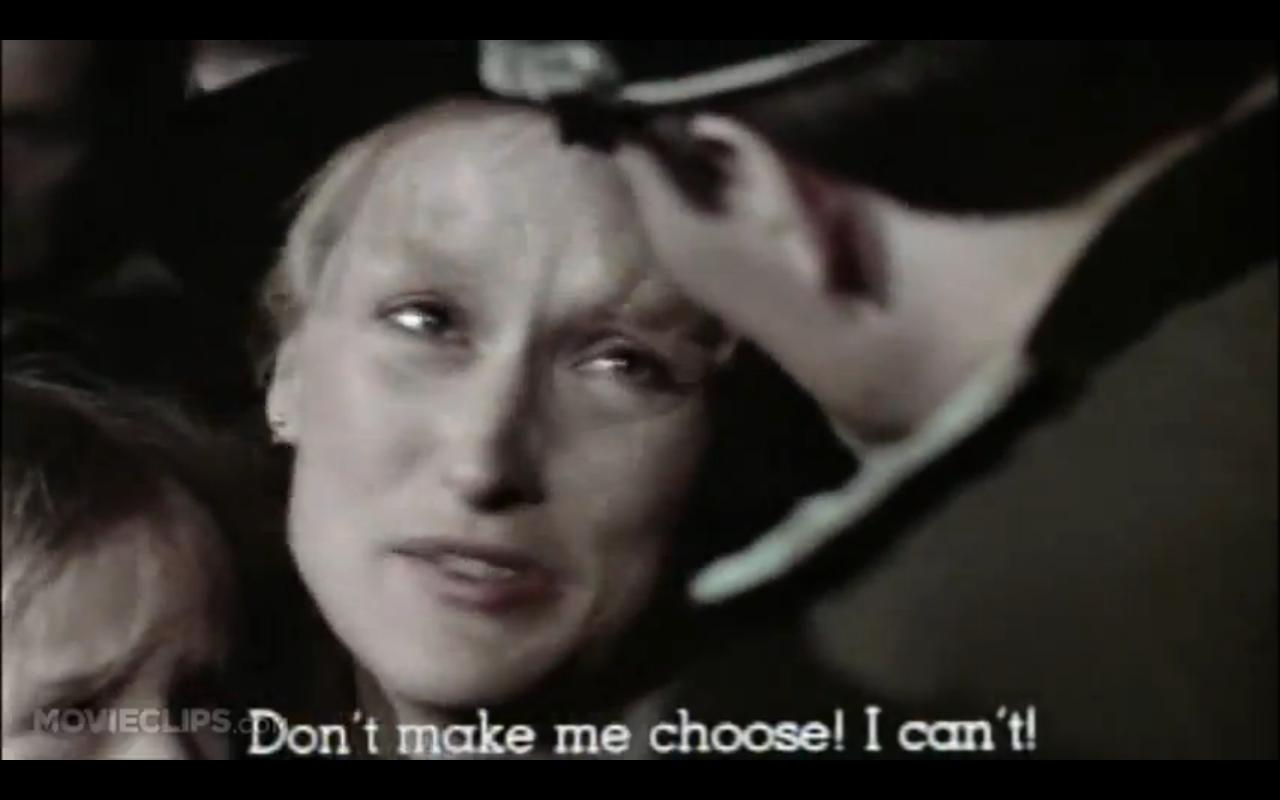
In contrast to most of the films,
which we watched in their entirely, “Sophie’s Choice” was a film which we only
watched a small portion of, literally minutes.
However, those few minutes had a huge impact on me. The scene portrayed Sophie being made to make
an impossible choice by a Nazi officer: picking between her children. The scene was meaningful to me because it
made me realize how momentous a small moment was. It also made not only the physical torture,
but also the emotional and mental torture the Nazis put innocent people
through. After thinking about it a lot,
I honestly would not have been able to make a decision like Sophie did. I learned from this how a single moment can
be completely life-changing.
Another movie that was meaningful to
me was “The Boy in the Striped Pajamas”.
This film was different from any other film we watched because it dealt
with extremely difficult, dark material through the eyes of a child. It was a completely different
perspective. Bruno, the protagonist, did
not really understand anything about the Jews or the Holocaust. All he knew was that he had a friend who was
the same age as him, that they got along well, but who lived a completely
different life, and who, for some inexplicable reason, was separated by a
fence. This film really showed me the
Holocaust through fresh eyes. The
personal lesson I learned was that sometimes, you need to look at things
through the perspective of a child and not bring so many judgments and previous
opinions in. Although Bruno paid the
ultimate sacrifice for his friendship with Shmuel, I’d like to think that if he
had grown up, he would have been against the Nazi regime, partly because of
that friendship.

Personally, the hardest film for me
to watch was the portion of the liberation videos that were taken when the
camps were freed by the Allies. Many of
the images made me feel physically sick, and I often had to look away. These people that were imprisoned there made
the ultimate sacrifices; though they survived the camps, their lives would
never be the same. The complete physical
deterioration of most of their bodies and the haunted looks in the eyes will
remain will me forever. Additionally,
the piles and piles of dead bodies were staggering. There is a quote by Stalin that I’ve read
before: “One death is a tragedy; a million is a statistic.” It is a huge disrespect and complete shame to
think of these victims in this way. Each
of them had their own families, friends, likes, dislikes, full vivid
lives. This film, more than any of the
others made me realize this. The
Holocaust was an instance in which we were too late, we failed to do the right
thing to preserve the precious human life that was lost. The lesson I learn is that this cannot happen
again.
Although many of the films in this
class were extremely depressing to watch, there were bright spots. The film “Freedom Writers” was one of
them. If watching the liberation videos
and Sophie’s Choice made me extremely sad and angry, “Freedom Writers” gave me
hope for the future. I have huge admiration
and respect for the teacher Ms. Erin Gruwell, who, through her determination
and small steps, was able to completely change the lives of her students. She is a true role model.

These
films were only a few of those that we watched.
Everyday, I was, to use Mr. Gallagher’s language, “bombarded” with
images, both good and bad. What Facing History and Ourselves means to me
can be boiled down to this: The Holocaust may have happened decades ago, but
that doesn’t mean we can forget about it; in contrast, we need to learn lessons
from it and then apply that to atrocities still being committed today, ones we
can affect. If anything, after having
taken this class, I am still optimistic for the future; I am now more inspired,
motivated, and determined than ever to do my part to make the world a better place,
whether it be through small actions or large.
Works Cited
Boy
in the Striped Pajamas. Google Images.
Images. 13 January 2014
Freedom
Writers. Google Images. Images. 13
January 2014
Milgram
Experiment. Google Images. Images 13
January 2014
Nazi
Youth Salute. Google Images. Images.
13 January 2014
Sophie’s
Choice. Google Images. Images.
13 January 2014.

No comments:
Post a Comment